Saturday, July 20, 2013

Colic Help

Colic is one of the hardest things to deal with, when you have a newborn. Whether you breastfeed or not. The beauty however with a breastfed baby, is that colic can be fixed sometimes a whole lot easier.
I say that because you have very few options when you’re not breastfeeding. There are many avenues you can take with a breastfed baby, to relieve or eliminate colic all together.

How do you distinguish colic from other ailments? Typically, if your baby is screaming for hours at a time, pulls her knees up to her chest, and sometimes can see a blue tinge above the upper lip - it’s colic. Colic is air/ gas trapped in the bowel, the bowel spasms causing pain to the baby.

What can you do to help your baby?
* Check that you don’t have an overactive let down . (http://kellymom.com/bf/got-milk/supply-worries/fast-letdown/) Your baby’s colic could be the result of too much air being gulped whilst feeding, typical of a baby trying to keep up with a fast flow. Watch and listen to your baby whilst feeding and let down. If you notice baby is gulping down air, try feeding baby in a more upright position (Biological Nurturing: Laid-Back Breastfeeding ). Lie on your back with baby lying on top of you to feed. Or take baby off the breast at the beginning of your let down, catch the spray in a towel or bowl ( to save) then relatch.

* What are you eating? Often what we eat is a cause of colic in infants.All babies are different, so it becomes a process of elimination. Write down everything you eat, and see if your baby is more affected the next day by a particular food.

* Are you taking fenugreek? Fenugreek is a cause of colic in infants, and can be blamed if baby did not suffer before you started taking the supplement. It is known to upset babies tummy.

* Are you eating oats? Oats are another cause, one I personally didn’t know, and ended up with a severe colicky baby for 4- 5 weeks.

* Dairy proteins - If you have tried your elimination diet, next try cutting out all dairy. Remembering it can take up to 3 weeks for dairy proteins to leave your systems.

* Colic drops/ gripe water/Probiotics - Some babies will respond very well to these products, remember to check labels for no added alcohol. If you can find a drop with fennel and ginger in it, those will naturally help to ease tummy pain. Probiotics have been proven in recent studies to be just as effective as gripe water.


Some other things you can try to help alleviate babies symptoms of colic are :- Pumping babies legs as though she’s riding a bicycle.
Massage baby’s belly in a circular clockwise motion with a little coconut or almond oil with 1 drop of lavender oil added.
Warm baths with a few drops of lavender oil in the water, can be a god send for mother and baby alike.
Remember too, to nurse as much as baby wants, being at the breast is often a way that calms you both, and quite often calm baby enough to pass so much gas your eyes start to water!
Wear your baby as much as possible, your movement throughout the day is often a great help to shift baby’s gas.
Lay baby on her tummy on a firm bed or couch, rub, pat, jiggle her butt from side to side.

If none of these suggestions work, there is still light at the end of the tunnel. It doesn’t last forever! Baby will grow out of it. The best advice I can give in that situation is to invite as many close friends and family members as you can, often, to come over to help out. Whether that means comforting the baby, washing the clothes, or cooking dinner. The help will be appreciated, you will need it - so take it!


A baby with colic is heartbreaking, emotionally and physically exhausting. A range of emotions and fears will bombard you. When your baby screams and screams, you feel as though you’re doing something wrong. Or worse - failing your baby. Remember you’re only human. It is normal to feel these things, but you must also remember that it is just one of those things. There is no fault, there is no blame to be laid at anyone's feet. At the end of the day, you do your best for your baby. Keep nursing, keep trying to find that thing or the many things that will help make your baby comfortable. Know that in doing those things, you are doing the best for your baby, and it will pass.

Breastfeeding Myths Uncovered


Quite often we hear of myths that end up ' booby trapping' women into discontinuing nursing their babies. So lets clear some of them up.

* you must breast feed every 2 - 3 hours.

* I can only pump a small amount, my milk is drying up

* my baby is fussy, my milk supply is going.

* my baby only gained a small amount of weight, I'm starving my baby.                  

* my milk has quantity, but not quality                              

* you can't breast feed while pregnant

* I have to drink milk to make milk.                                  

* I can't keep up with baby's demand.

* breast milk loses nutritional value after 1 year


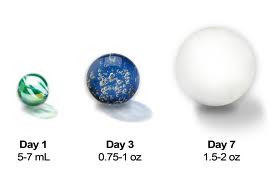
Lets start with the first point: *Breast fed babies should always be demand fed. In the early days straight after birth, baby's stomach is the size of a large marble. At about 1 week, it's the size of a golf ball. That little tummy has to be filled often, breast milk digests quickly, so baby becomes hungry. Breast feeding is also about comfort and building a trusting relationship with your baby. If you deny the breast because you view it hasn't been long enough between feeds. You are literally making your baby go hungry. If you deny the breast for comfort, you are telling your baby, that you won't meet his needs. I encourage you all to research " the fourth trimester". Your baby's instinct is to be attached to you, he is a wholly dependent being, his instincts tell him that to be away from you, means death. Don't fight it, go with it!


* I can only pump x amount: Your pumping out put is absolutely no indicator of how much milk you make. Your baby can drain your breast efficiently and effectively. A cold machine, doesn't do the same job as a baby, yet merely mimics it. Many women do not respond well to a pump, but manage to successfully nourish their babies. The only true indicators of a low milk supply are, less than 6 - 8 wet/ poopy nappies per day. No growth at all, meaning no weight gain and/ or growth in length and head circumference, no little fingernails needing clipping.


* My baby is fussy: There are plenty of reasons baby becomes fussy, rarely is it an issue with supply. Baby may have gas, have a sore ear, teething, too hot, too cold, overstimulated, too tired, perhaps a over active let down, perhaps a long period before let down, something in your diet has changed, maybe a growth spurt. There's so many reasons why babies fuss. Don't automatically think it's your supply, believe in your body's ability to feed your baby. Unless you have true indicators of low supply, look for other causes.


* My baby only gained a small amount of weight: There is more that goes into growing a baby than weight gain. If your baby has only put on 3 oz, but has grown an inch in length. Your milk is just fine, the calories have gone into growing baby up, rather than out in that particular time frame. Look at what other things your baby has been doing that week. Has he been sick? Has his head grown? Has he been sick? Has he started crawling? Or walking? Babies grow at different rates, there is no golden rule that says your baby must be the same as everyone else's. Always remember that genetically, some babies will be small, some babies will be average, and some babies will be big. If you or your partner are fine framed, chances are baby will be too.


* My milk has quantity, not quality: this particular myth drives me nuts. This myth usually stems from a fussy baby, or a baby that isn't gaining a pound a week. All breast milk contains the same nutrients, anti bodies and fat content. Mothers diet does not affect the quality of her milk. The ingredients in breastmilk are vast, and breastmilk is a living substance. Yes ratios vary, typically due to the age of the baby, and what stage that particular baby is at. Eg anti bodies and fat content are higher in breast milk of a nursing toddler than a new born. As previously stated, a fussy baby or slower weight gain is no indication of milk quality.


* You can't breast feed while pregnant: Completely untrue. Many, many mothers can nurse throughout their entire pregnancy, then tandem feed once the new baby is born. In some women, the hormones will cause a lower supply or a sour taste to their milk. But this is not always the case. The only time nursing during pregnancy is contraindicated is if the mother is on pelvic rest due to pre-term labor, or risk of. That doesn't mean if your doctor says you have to stop nursing because there is a risk.


* I have to drink milk to make milk: No you certainly don't! There's no harm to drinking milk (unless your baby has a dairy intolerance) but there is no scientific research to suggest this is true. Keeping hydrated with water and maintaining a healthy diet are better requirements to ensure a healthy supply.


Introducing Solids The Easy Way; Baby-Led Weaning


What do you think of when you hear the phrase, "Baby-led Weaning"? When my oldest was a little one, probably around 10 months old, I became obsessed with how we were feeding him. He was spoon fed purees, and was starting to reject the chunkier purees. I always home made all his food, and I couldn't figure out why he just kept spitting the chunks back at me. I started searching Amazon for baby food books, I found the classic puree books, but in my quest to discover them I came across another book. "Baby-led Weaning". "The Essential Guide to Introducing Solid Foods - And Helping Your Baby to Grow Up a Happy and Confident Eater," it boldly proclaimed. I was so surprised that had I never seen this before. This is exactly what I had been looking for, right? Who doesn't want a happy and confident eater?

*
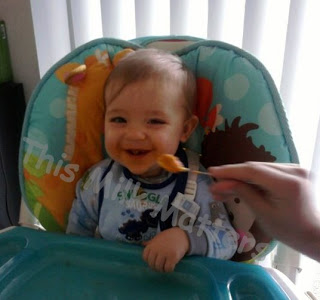
My oldest, 11 months and still spoon fed

So I bought it and I read, and I thought "This is insane!! Who would give a carrot to a 6 month old! Are these people crazy?" I dismissed the whole book, put it into my inventory on my kindle, and didn't think of it again.


Fast forward 18 months. My second son was a few months old, and the topic of starting solids came up in a group I was in. By this point I knew that we would be skipping rice cereal no matter what, but I was still planning on pureeing my own food. I had a nagging thought in the back of my mind, but I carried on with my plans. Around 5 months people started to ask "So, when are you going to feed him cereal? What food is he going to get?" One of my friends mentioned that they would be doing baby-led weaning with her baby, who was the same age as mine, and that's when it hit me, I had read that book! I decided to give it a second chance, I pulled it back out and read it again.


I will tell you, I was scared of baby-led weaning. What if he chokes? What if it doesn't work? Doesn't he need the food? He won't eat much, so how will he get nutrition?


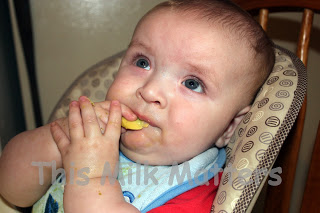
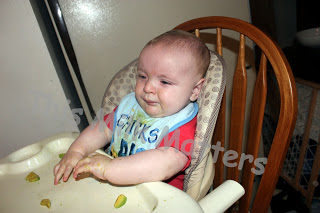
First taste of Avocado - 6.5 months
*

Baby-led weaning really is an amazing thing. We chose to use it, instead of puree's for our second child, and I couldn't have been, and still are, happier with his introduction to food.


Here are some of the great benefits of baby led weaning:


- Baby-led weaning happens when the baby is ready. A lot of times babies are given food before they would be ready to eat it. Your baby needs to be sitting unassisted, with no tongue thrust, and at least 6 months old before getting any solids.


-Baby-led weaning allows babies to choose when they want to eat. Food before one is just for fun. The main source of nutrition for a child under 12 months should be breast milk. Solids should not be the bulk of your baby's diet. Allowing your child to go at their own pace, through baby led weaning allows them to slowly up their solid intake.


*
Oh, that tastes funny!

-Baby-led feeding is what breastfeeding is all about anyways. When your baby is first born, one of the most important things we hear is "Feed the baby when he is hungry, no schedules, no waiting, if the baby is hungry, feed him." By doing that we teach our babies multiple lessons, one of them is to eat when they are hungry. Baby-led weaning allows babies to eat when they are hungry, and the BABY chooses when they are full, not the mom trying to airplane in a spoonful of squash. Baby-led weaning is the perfect extension to baby-led feeding.


-Baby-led weaning allows babies to follow and learn their own body cues. When you spoon feed a baby, you feed them till you feel they are satisfied, or until they seem to be done. But how do we know they are really done? How many of us have "choo-choo'd" the spoon into the mouth, trying to get a few more bites and finish off the jar? When you breastfeed, your babies get to decide when they are full. They comfort nurse instead, getting no milk, or they pop off the breast. With baby-led weaning those same babies continue on learning the same things they were taught at an early age. They stop when they are full, they eat till they are done, and no one cajoles them into taking anymore bites.


-Baby-led weaning teaches babies to chew, before it teaches them to swallow. I don't know about you, but I would rather my baby learn to chew his food before he learn to swallow whatever I put in his mouth. Chewing is very important, if I do say so myself. Watching my 7 month old move food around in his mouth, gum it down, and swallow it was an amazing experience.


-Baby-led weaning is an amazing sensory experience. With baby-led weaning you are feeding your baby whatever you are eating. Babies get to smoosh, and smash, and hold slippery food. They get to taste different textures, rice, pasta, banana, carrot, etc. They get to see the beautiful food on their tray. It really is an amazing learning experience all around.

*
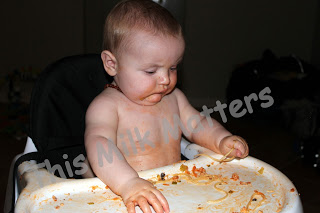
Learning that Spaghetti is slippery, and yummy


-Baby-led weaning does lead to confident, happy, well rounded eaters. I have talked to many moms, and I have found the same thing. My oldest is a picky, picky eater. He is finicky about his food. My youngest will eat anything we put in front of him. He loves food. He has gone through many little picky phases, I'm not saying baby-led weaning babies are not picky, they go through those stages as well, but they seem to rebound a lot quicker, and move forward. He is an adventurous eater, trying new tastes often.


I'm not saying that puree fed babies will be picky, horrible children, swallowing everything in their path before they try chewing it. I'm simply saying that baby-led weaning is an amazing extension from breastfeeding. I want to teach my children to follow their own instincts, I want them to learn to trust their bodies, I want them to know that I trust that they can nourish themselves, and teaching them to eat confidently, by breastfeeding and allowing them to feed themselves, is the best way to do that.


*
7 months, eating a whole apple
The first time my 8 month old picked up a whole plum, chowed it down and spit the pit out at me, I was stunned. His older brother wouldn't even touch plums! Was I initially worried about choking? Yes, but guess what, he never, ever choked. He gagged a few times, and spit up once when he was gagging, but he never choked. I was right there supervising him every time he ate. We took a baby cpr class which I advise all parents to do, no matter how you feed your baby. We knew how to deal with an emergency, but we never needed to. I feel confident now that he won't choke, or over-stuff his mouth, because of how he learned to eat.


Trusting my baby to feed himself, and learn about himself, watching him use his instincts, has been one of the best experiences I have had in learning about my child. It has been an amazing experience.


For more info check out the book about Baby-Led weaning, linked at the top.


Thursday, March 14, 2013

Facebook Takes a Dig at TMM


This week has been a busy one for Breastfeeding Photo removals, including right here on This Milk Matters. Monday Morning, TMM received a report from a mom whose Aunt had verbally attacked a pumping photo of hers, which was later removed. Our team reposted her banned notice, only to have it removed from our page as well. We reached out to advocate Jodine Chase for support. 


Unfortunately, this story only gets more annoying. That morning, Jodine Chase received a 30 day ban for sharing a side by side image of two photos found on facebook. The photo of the nude body, Facebook claimed did not violate their policy. The photo of the nursing mother, apparently had. Here at TMM we shared the BLOG detailing her removal with the following statement: “Facebook strikes again. TMM has had pumping photos removed, and Jodine Chase was recently banned for publicizing the clear bias against Motherhood and breastfeeding on Facebook.” 


Does the mere act of speaking out against Facebook’s obvious screening discrepancies warrant the banning of 5 TMM admins, and warnings of 8 more? We don’t believe so.

So here’s what we need to ask ourselves, are we going to continue to take the runaround from Facebook? That this is all an error, a random act that has no real consequence to our community? Facebook is taking a hit at our freedom of speech with this recent removal, our dignity by not making a lasting change that could fix this unfortunately common occurrence and finally; a dig at our patience. This ban effects more than just me at TMM, it effects all 13,000 of you. You expect us here 24/7, because thats what we've promised you, support when you need it. If we are constantly battling error, we aren't doing that. This matters.

Please take a moment to view the photos we have shared here, the blogs we have linked to, and sign this petition for facebook to amend their breastfeeding policy. Your help is imperative, until we are an united voice, one that is relentless in holding Facebook accountable, nothing is going to change.

Thursday, January 10, 2013

Nursing in Public, The Controversy

It seems like recently NIP has become a hot topic button again. Holister, Concord Mall,
Las Vegas, Bribie Aquatic Centre, and even on a morning talk show, breastfeeding has been berated, moms have been told to cover up, or forced to leave because they were feeding babies.

On a facebook page, or a news station, they asked for peoples opinion on the NIP issues. Responses included -


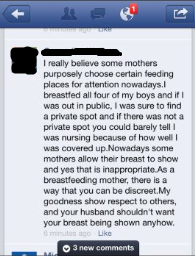
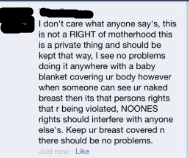
Yes, you read that right. One person said that it is not a mothers right to nurse her baby in public, in fact it is other peoples rights that are being violated by having to see a breast. I wonder, does he feel this way when he sees a woman in a bikini? Or in a low cut top? Or does he just feel this way when he sees breasts being used for what they are intended (feeding a baby) and not for his pleasure.

The other woman said that we should show respect to others, by covering our breasts, right? Our husbands don't want us showing off our breasts when feeding our babies? Well, I'll tell you what, women of the world, stop wearing bathing suits, and in fact, please start wearing turtle necks everywhere!! We wouldn't want someone else to be disrespected because they glimpsed a little cleavage! Oh wait.......that's not the issue, showing off our breasts when we wear what we want, or when celebrities take topless pictures for magazine covers isn't the issue, that's not disrespectful. It is so very disrespectful to nourish your child in a biological, normal, healthy manner! (please read sarcasm there).

How did we get to this place? How did we become a society where it is more important to respect a complete strangers feelings then it is to feed your child? How did we get to a place where our child's right to eat, and be respected to eat healthfully and naturally is considered disrespect? When did we start devaluing an infants right to be nourished whenever they decide they are hungry?

In the past few generations we have seen a switch, from caring about each other to caring about ourselves. I don't want to see it, so you shouldn't do it, is the new mentality. No one stops to take a second and think about the baby, who is hungry and needs food. No one stops to consider that they have eyes, and a neck that turns, and they are fully capable of using them.

Let me tell you, I am vegan. I do not like to watch people eat meat, or cook it, or anything. It grosses me out. When we go out to eat I have two options, eat my food happily and not pay attention to others, or sit and stare and feel grossed out. How would it go over, do you think, if I went around to each table and asked the people eating to put a blanket over their head (or take their food elsewhere) so that I didn't have to see them eating their food? What if I complained to the manager and asked them to tell people to move away? Do you think that I would be taken seriously? I am sure that I would be laughed at, and told to mind my own business, and look away. How is it that adults eating is more important then babies eating? Shouldn't we value the nourishment of our next generation?

Mothers, please don't be afraid to nurse your babies in public, where ever you are, no matter how you choose too. Here's the thing, if we ever want to make it normal to nurse, we must present it as normal. That means we need to nurse our babies when they are hungry. Covered, uncovered, it doesn't matter, what matters is that you are doing what you were made to do, and you are raising a new generation that will respect nursing, that will find it normal, and praise it. Nurse on mama's, lets make this normal, in hopes that our little girls, and our little boys wives, will be able to freely nurse without the worry that they may be asked to cover, or move, or leave.

Saturday, December 15, 2012

Herbal Help for Low Supply

The holidays are a stressful time for everyone, but especially for moms. We get so busy cleaning, hosting, worrying about in-laws, buying presents, chasing kids, and baking goodies for everyone else that sometimes we forget to eat ourselves, let alone drink enough water during the day. On top of this some moms have work, or school. This time of the year is a busy time for most of us. We need to go, go, go; but most nursing moms forget that they need to stop for a minute, take a bite of something, and a big swig of water.

Sound like you? Fear your supply may drop a bit due to stress? If this you, even when it’s not the holiday season? Don’t worry mama, you are not alone. Even without the holidays, life is stressful, we get busy and sometimes our supply may take a hit. That’s why I’m sharing some tips and tricks to help maintain your supply, and if it does drop, to help bring it back up naturally.

First, remember that the only way to tell if your milk supply is low is through babies output. If your baby is having 6-8 wet/dirty diapers a day, then your baby is getting enough milk. If you feel like your milk supply is low, it won’t hurt to take some sort of herbal supplement, but you don’t have to if babies output is enough.

If you have tried the normal advice, such as, nurse more often, offer often, skin to skin, up water intake, and oatmeal (side note: Some babies react to oats, and have a hard time with mom eating them. They get gassy and colic-y, so use sparingly), then read on!

Any of these herbs may be taken as a tincture (under the tongue) or in capsule form. It really just depends on your preference. Always start with the lowest dose possible and build up to more if you don’t see any difference. Give the herb at least 4 days to work before upping your dosage. Please make you are comfortable with each herb before you take it. Also, speak to your naturopath or Dr about these herbs. I want to stress that the following information is just suggestion, not a treatment plan for a specific mother. Herbs should only be used for a few weeks, a month at tops, to help your milk boost up until baby can naturally pull it up.

First I want to address an herb that should not be taken, in high doses, while nursing. It is a common herb eaten during the holidays; peppermint. Peppermint can decrease milk supply. I know we all love peppermint mocha’s, peppermint lattes, candy canes and peppermint patties, amongst other peppermint, but be wary of this oil and herb (the artificial flavoring will do no harm). It may decrease your supply. If that happens these tips will help increase it again.

Alfalfa is an herb that is often used to help up supply. It is a pretty powerful herb full of lots of nutrients, including chlorophyll and fiber. It can cause diarrhea or loose stool in mom or baby. If this happens just reduce the dosage for a few days. Doses as follows – 1-2 teaspoons per cup of water, drink this up to three times a day. You can also take up to 8 pills a day. Avoid Alfalfa if you are taking blood thinners.

Anise can be taken (yes the spice) to help increase milk supply. The perks of Anise is that it is also a herb known for helping with digestion, upset stomach and colic, so if mom is taking it the affects will carry over to baby. The best way to take Anise is in tea form. Gently crush 1 - 2 teaspoons of anise seeds, and cover with one cup of boiling water. Cover and steep between 5 - 20 minutes. Sweeten it to your liking. You can take up to 3 cups a day.

Blessed Thistle is a fabulous herb. It helps with milk supply, but it also helps support the liver. Blessed Thistle can be taken as a tea, 1-2 teaspoons per cup of water. Steep for 5-10 minutes and sweeten as needed. This can be taken up to 4 times a day. You may also take 3 capsules, 3 times daily.

Dandelion herb and root is another herb that helps support the liver while raising milk supply. It is a bitter herb though, so it may need some extra sweetener if taken as a tea. To take as a tea add 1 tablespoon to a cup of boiling water and steep for 10 minutes. Sweeten as desired. You may drink this up to 3 times daily. Dandelion is also good made as a decoction with other herbs, such as fenugreek or marshmallow or hollyhock root to boost supply. Gently simmer 1 tablespoon (of herbs total) of finely chopped fresh, dried or powdered root in 3 cups of water for 10 - 15 minutes.

Fennel is a good herb for upping supply, as well as colic relief. Moms and babies both will enjoy the benefits of this herb. It may also be eaten in its true form, as fennel seed, or fennel root. Fennel root is good roasted, or sliced into a salad. As an herb it can be taken as a tea, gently crush 1-2 teaspoons of the seeds, and add one cup of boiling water. Cover and steep for between 5 - 20 minutes. Longer steeping produces a more potent tea. Sweeten to taste.

I want to touch on fenugreek, it is one of the most known and advised lactation herbs. Fenugreek is not to be taken during pregnancy. Be careful with fenugreek. It is usually the last herb that we reccommend, and even at that it is with hesitation. Fenugreek can make both moms and babies have upset tummies. It can make babies appear reflux-y, colic-y and gassy. It can make moms "bulk up", and give mom diarrhea. It is not supposed to be used long term, three weeks is the limit, and when you cease taking it, it can cause your supply to drop again. It also can not be taken by people who are hypoglycemic.
If none of these things work, talking to your Dr about a prescription to help with milk supply is probably a good option. Remember; when it comes to nursing during the holidays, most drops in supply will simply be from stress and slight dehydration. Make sure you are taking care of yourself in order to take care of your milk supply!
All herbal dosages can be found at Motherhood International as well.

Friday, November 30, 2012

Breastfeeding in the Holiday Season: TEN WAYS to Eliminate, Educate & Elude Confrontation

Becky James, Guest blogger from Naturo-Mommy, and admin for TMM shares with us some tips and trick for breastfeeding during the holidays.


Photo courtesy of www.lactivist.co.uk


The holidays are a wonderful time to get together with family and friends. The warmth and cheer and the good food are enough to fill a person's heart with contentment to advance into the next year in a good way. I, for one love Thanksgiving, Christmas and New Years. And for those that don't celebrate these holidays, there is Hanukkah, Kwanzaa, Ashura, among many others. Breastfeeding can be daunting in and of itself. A lot of women don't have the courage to do it in public, around strangers. Breastfeeding around family members who are unsupportive or unfamiliar with it can be even more daunting. One reason being, that you know them and you have to face them on a regular basis. Or, at least, once a year.

You may be confronted by family members with rude comments or dirty looks and feel the need to leave the room to avoid these confrontations. If you feel most comfortable being in another room, by all means, do what you feel suits you best. But for a lot of breastfeeding mothers, they may not want to leave the room and miss the festivities. Which, in a lot of cases, you may be there longer than one feed for your baby or child and this can cause a lot of missed time with family and friends.

If you feel you may be confronted at these gatherings, there are many ways to go about avoiding them or standing up for yourself and your baby to make your holiday stress free and family friendly. I have asked some mothers to share their experiences, breastfeeding during the holidays. Here are a few:


Jessica writes:
'My youngest son was born in March, so by the time Thanksgiving came around
that year, he had already passed the "recommended" '6 month cut off'. I had never been shy about nursing in public, and
my family knew that well. I would proudly lift my shirt anywhere and
everywhere. Thanksgiving that year, I'm at my aunts house, trying to eat my
food, get my then 3 year old to eat anything I could get him to try, and my
8 month old was hungry.

I put him in the ring sling and situate it so no one could really see anything other than his
head, just out of respect for it not being my home. My uncle got up and left, came back
and grabbed his children. That made other family members take notice and they all got up
and left. Then designated my aunt to come in and tell me how inappropriate
that was to "whip out a tit" at the family table. And how no one felt
comfortable eating in the same room as me, if I could please go eat alone,
in another room. I smiled and said no, and continued eating. After that, I
didn't speak to anyone. I made an extra plate to take home and packed up
and left.

By Christmas I thought it was settled. We arrived at Christmas dinner though, and
the first thing out of their mouths was asking if I brought a bottle so I wouldn't flash people
again.

I wish I could say that my story has a happy ending, but it never happened. I went on
to breastfeed my son fora total of 29 months. My family is still very unsupportive of
breastfeeding but I don't let it bother me, and I have no plan on adjusting my "behavior" for
their needs, as my job is to fulfill my child's needs.'

Lisa says: '"You're STILL breastfeeding? Isn't he going to become too dependent on you?! (said of my then 1.5 yr old)…"'

Jennifer writes: "My husband’s parents came up for a belated Christmas this past January. At the time, my daughter was 5.5 months old and still exclusively breast fed. I didn’t think anything of nursing her in the living room with my in-laws in the room. Apparently, this made the step dad uncomfortable, but we didn’t know that until a couple days later when my husband's mom called to tell him. They expected me to go into another room to nurse my baby, in my own house. My husband was appropriately outraged, as was I. His mom even went so far as to say, and I quote, “I don’t appreciate her whipping out her breast in front of my husband.” As though I was trying to seduce a man twice my age by feeding my baby. Since then, the relationship has been strained, at best. It’s unfortunate that people are so narrow minded and prudish about the act of breastfeeding, but I refuse to alter the way I feed my children simply for someone else’s comfort, especially within the walls of my own home. I’m still breastfeeding my daughter, now 15 months old, and I don’t plan to stop anytime soon."

There is also attire you can wear, so that if it's not practical or comfortable to cover, you can go uncovered without showing much. When in public, I do not cover because we are not comfortable that way. I wear a tank top under a shirt and pull up the t-shirt and pull down the tank top. Of course, there is nursing attire, but if you're on a tight budget, like me, you work with what you have. There is often little to nothing shown when I use the shirt-tank method and we're both happy that way.


While these situations are often unavoidable, there are ways to diffuse them. Here is a list of 10 things you can do or say, if you are comfortable:

1. Using a cover is always an option, if you and baby are comfortable.
2. You may use this time to educate family members or friends. Just a short blurb about the benefits of exclusively breastfeeding or extended breastfeeding.
3. You may say things like "That sounds like it worked out for your children, but this is what works for our children and we are happy."
4. Get the support of another family member or your spouse beforehand to intervene, so you have an advocate.
5. Laugh and make a joke about how you promise not to wave your nipple like the breastfeeding banner without a child attached.
6. If they mention that there are children in the room & they don't know what to tell them, offer to explain to the children what is happening so the parents don't have to try to answer their questions.
7. When talking about breastfeeding, remember to smile and sound light hearted. Hopefully, putting off the defensive stance your family member or friend may have.
8. If you're asked why you haven't put it in a bottle, explain that you (and these are just examples) a) can't pump b) baby won't take a bottle c) you couldn't pump enough for baby for the holiday gathering d) you forgot your pumped milk
9. If they offer solids, say that you're worried about an allergy or tell them that it is not recommended by AAP or WHO to introduce solids before "X" months or that they can't have (insert name of food) until "X" age.
10. Your baby may have teeth and this also may prompt comments about solids: "Your baby should be eating food since he has teeth." "You're breastfeeding AGAIN? Here, give him this." You could say: "No thank you, we haven't introduced that into his diet yet."

I hope that giving these examples and experiences have helped you go into your holiday season a little less stressed and more confident in your choice to breastfeed your baby. Happy Holidays!